Moving AI Agents to Production: Why Capability Isn't Enough Anymore
The challenge for AI agents has shifted from proving capability to ensuring reliability, governance, and cost-efficiency in real-world production.

The demo era is behind us
For a long time, it was enough to show an agent using tools, chaining steps, and delivering a convincing response for the future narrative to hold up. This worked because capability was still the big novelty.
But production completely changes the bar. In a real environment, the agent doesn't just need to look smart. It needs to be predictable, auditable, secure, and economically viable. And that is exactly where many projects start to stall.
What the market thought was the problem — and what the problem actually is
If the agent fails, then the problem is the model: it lacks capacity, reasoning, or a better prompt.
In practice, the bottleneck is usually in the operation: too much context, too many tools, little supervision, poor logs, and insufficient governance.
Why agents stall when they reach the real world
In most cases, the problem is not a lack of intelligence. It is a lack of system. Agents in production suffer when they need to handle multiple integrations, chained decisions, external dependencies, and unclear execution policies.
context grows quickly and degrades performance;
cost per task becomes difficult to predict;
failures in external tools multiply;
without proper observability, errors become invisible until they impact the user;
without fallback and policy, autonomy becomes an operational risk.
The mistake of treating an agent as a complete product
There is a recurring confusion in the market: imagining that the agent, by itself, is already the system. But it is only a decision layer. It does not solve governance, routing, auditing, fallback, cost, or security.
That is why so many implementations look excellent in the playground and fragile in production. The team designs intelligence, but forgets to design operation.
This is where the control plane comes in
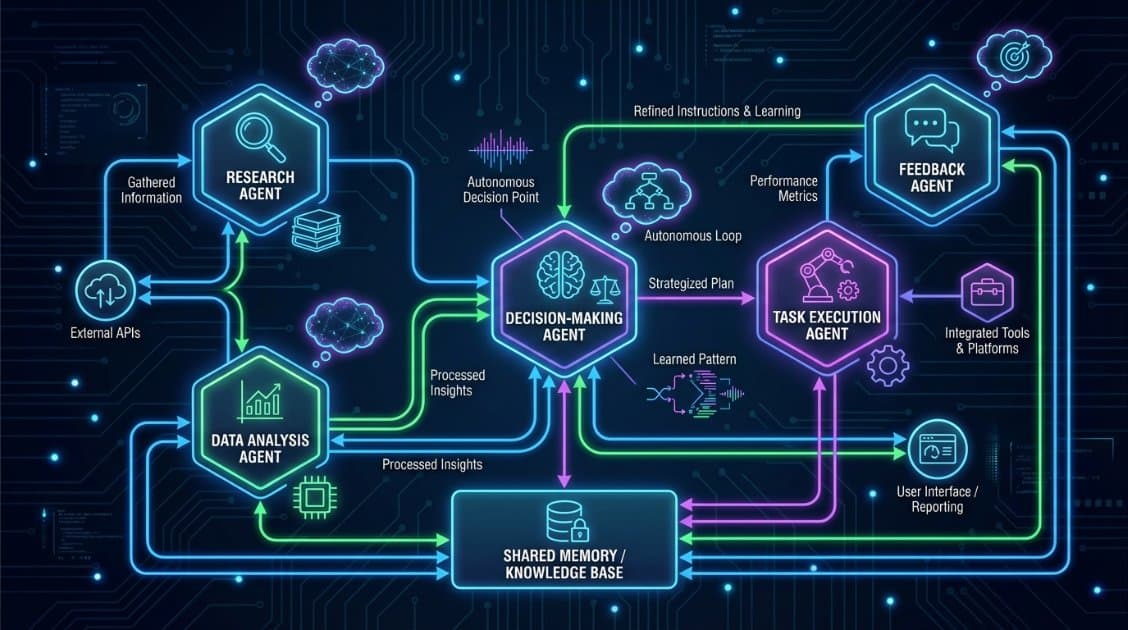
The control plane is gaining traction because it answers the question that the first wave of enthusiasm ignored: how to coordinate agents without turning the entire operation into an expensive improvisation?
policies, permissions, routing, retries, logs, observability, cost, and traceability.
agents stop being just demonstrable capability and start operating as part of a controllable architecture.
When the conversation matures, it becomes architecture
This debate matters because it shifts the conversation from technical fascination to operational discipline. The future of agents looks less like a universal genius solving everything alone and more like a coordinated mesh of models, tools, policies, and observability.
This also explains why subagents, control planes, MCP, governance, and smaller models are appearing together in the same discussion. It is not a coincidence. It is the market discovering that capability without structure does not scale.
Conclusion
AI agents remain one of the most promising frontiers in technology. But the current phase requires a different kind of maturity. It is no longer enough to prove they can act. Now it is necessary to prove they can operate with seriousness.
In the end, the issue is no longer just intelligence. What is at stake now is operational trust. And that is where production stops being a detail and becomes strategy.
Original source:The New Stack
URL: https://thenewstack.io/agentic-ai-control-plane-production/
The elite dev's arsenal.
Conversational AI Exhausted? How to Migrate to Agentic Workflows and Execute Real Actions
The chat paradigm is exhausted. Discover agentic workflows: systems that plan, execute, and verify tasks autonomously and in a testable manner.

GLM-5.2 vs. Kimi K2.7: Why GLM Wins the Code Reliability Test
Five independent evaluators tested GLM-5.2 and Kimi K2.7 on coding tasks. Discover which model wins the battle for reliability and development speed.

How to choose an AI SDK: why the fear of lock-in is a mistake and how to decide based on your app's format
The fear of being locked into an AI provider is a common mistake. Learn how to choose the best SDK based on your project's format and productivity.